2022

Invitation to the final multiplier event of NEWSREEL2

In the representation of NEWSREEL2 team, we would like to invite you to the final multiplier event of the project with the title of New Skills and Teaching Challenges for the Next Generation of Journalists: Presenting NEWSREEL2 Outcomes and Discussing AI and Journalism. The event will take place at the ISCTE-University Institute of Lisbon, Portugal on the 30th of March.

During the full-day event the project team will present the main outputs that were developed in the framework of the project. After a general project introduction, you will hear presentations from the project members in the following topics: verification and debunking, improving democratic sensibility, social media storytelling, foreign coverage, and Algorithms, robot journalism and AI.

The central field of the event is AI and journalism, therefore there will be a keynote presentation by Nic Newman from the Reuters Institute about threats and opportunities, as well as two round-table discussion with journalism educators and journalists.

We welcome anyone who is interested in our project results and the above-mentioned topics!


New Skills and Teaching Challenges for the Next Generation of Journalists: Presenting NEWSREEL2 Outcomes and Discussing AI and Journalism

30th March 2023 – Venue: AUDITORIO B1.04 - University Institute of Lisbon


9h    – Check-in

9h45 – Welcome

10h    - “What skills are essential for future journalists and how should we teach them? The results of the NEWSREEL2 project” (Annamária Torbó, University of Pécs, Hungary)

10h10 - 'Verification & debunking in crisis situations' (Raluca Radu and Antonia Matei, University of Bucharest, Romania)

10h20 - “Improving democratic sensibility in a fragmented media environment” (Klara Smejkal, Masaryk University, Czechia)

10h30 - “Curriculum development and pilot teaching experiences on social media storytelling” (Rita Glózer, University of Pécs, Hungary)

10h40 – “Teaching Foreign Coverage: Focusing on challenges and innovations in the field” (Dominik Speck, Erich Brost Institute for International Journalism, Germany)

10h50 – “Algorithms, robot journalism and AI” (Ana Pinto-Martinho and Miguel Crespo, University Institute of Lisbon, Portugal)

11h    – Q&A

11h15 – Coffee break (30m)

11h45 – Teaching for Artificial Intelligence in Journalism: challenges (Panel Discussion with Q&A)

  • Paulo Nuno Vicente, iNOVA Media Lab, FCSH – New University of Lisbon
  • Luís António Santos – Universidade do Minho, CECS, Minho University
  • Ana Pinto Martinho – CIES, University Institute of Lisbon
  • Moderator: Gustavo Cardoso, University Institute of Lisbon


12h45
– Lunch break

14h30 – Keynote: “Artificial Intelligence and Journalism: Threats and Opportunities.” (Via Zoom)

  • Nic Newman, Reuters Institute for the Study of Journalism, Oxford University, UK

15h – Q&A (15m)

15h15 – Coffee break (30m)

15h45 – Artificial Intelligence and journalism: practices and challenges (in Portuguese) (Panel Discussion with Q&A)

  • Alexandra Luís – Journalist (Lusa, Portuguese News Agency)
  • Rui Barros – Journalist (Público newspaper)
  • Moderator: Miguel Crespo


16h45 – Closing Session

17h    – End of the event


Are you talking to me? - Voice activated devices and journalism

The rapid growth of voice activate technology hasn’t been translated into interest in news consumption on these devices, as pointed out by several reports. Content development for smart speakers and voice assistants still faces many challenges in what regards consumption and production.

Human’s first tool for communication was speech, writing emerged very recently in human history. But in what regards the history of internet, first came writing and then it came sound.

The first voice recognition tool, IBM Shoebox, was created in 1961 and only recognized 16 words and digits. But the potential of these kind of developments was acknowledged and in the following decades other companies made progress in word recognition.

Although the “big leap” only arrived in the first decade of the 21st century, with Apple's launch of Siri in 2011. From then on, these voice tools gained the definition of voice assistants, as they were able to listen, respond and perform tasks through voice command. Since then, voice assistants became popular and easily accessible to the population.

There are 8 billion people in the world, around 66% have a smartphone, and most of them use a device with Android or IOS, so they have access to the usage of voice assistants. According to some surveys, considering all the devices, 45% of the Internet users worldwide use voice commands and voice search. And where do news stand in this picture?

Voice assistants and news

We cannot separate the discussion about voice assistant devices for news from the one about AI in the newsrooms, either in reporting, producing, or distributing news. This requires training, resources, and a wide ethical debate.

One of the first companies to experiment with the use of Artificial Intelligence through voice assistants was “The Evening Standard” in London, in 2017. That same year, BBC launched, in partnership with Amazon, their first full voice skill for Alexa. The following year “The Guardian” launched, together with Google, the Guardian Voice Lab.

The usage of voice-activated speakers has been growing, but, as some reports suggest, news usage remains disappointing, as the proportion using smart speakers for news is declining, at the same time devices become more mainstream. Less than four in ten access news via their device in the US (35%) and UK (39%), and just a quarter in Germany (27%) and South Korea (25%), according to the Digital News Report 2019. This from the consumption side.

As Google and Amazon look to provide more aggregated news services in voice it is likely that platforms will play an increasingly important role in this area. But a question still stands, are publishers interested in investing in new news services, building value for platforms without any path to self-monetization?

Platform power is likely to become an increasingly important issue for publishers over the next years as Google and Amazon look to provide more aggregated news services in voice. But many publishers may not be interested to invest in new services, building value for platforms without any path to self-monetisation. It is becoming more common to find research to explore the ways Artificial Intelligence (AI) can help communication professionals find and tell better stories.

Media outlets know how to safely develop products to be shown on TV, listened on radio, or read on Internet websites. But what is the best news product to be activated by voice assistants? How to present your news stories to be considered relevant and to appear as the first search result of these voice assistants?

The challenge of voice search

The adoption of artificial intelligence in newsrooms, either in reporting, production, or distribution of content, requires training, resources, and ethical debate. Training journalists and editors in general concepts related to artificial intelligence and subsequently in specific technical skills is crucial to promote an organizational culture open to the use of this technology.

Algorithms are fundamental in voice assistants’ companies. Although search by voice works in a different way than search in writing. When someone searches by writing in a search engine a list with several hyperlinks for websites appears. The algorithm defines a list of hyperlinks, and the reader has the option to choose from all the options that appear on the various results pages. But in the case of smart speakers, voice assistants would take a long time to present the same results. So, what happens is that the algorithm defines a single result for the user.

So, using voice adds new layers of complexity: we tend to speak in unstructured text. One of the things that makes resolution especially complicated for a large AI system like Alexa is that different Alexa services use different names — or slots — for the same data. Also, as voice interfaces proliferate in people’s lives, publishers and other organizations face a new strategic consideration: Is our content optimized for voice search? And, looking further into the future, how should we index our content for future forms of interaction? A new marketing area is already growing. Voice Search Optimization (VSO) is the new Search Engine Optimization (SEO), as companies will need to consider how their content is delivered via conversational interfaces.

Big challenges to surpass

There area lot of questions in what regards the use and content production for voice activated devices, but experiences are being made, and the interested in the field is growing, consistently.

Still there are big questions on what to do, how to do it and how to solve major language barriers and problems.

There are difficulties to identify the best kind of content, how to interact with users and how to monetize the contents are obvious. But the differences in consumption through voice interfaces, compared with the written interaction on other media channels, are also a big challenge to master by producers. In terms of knowledge and skills needed to work in this field, the specialists point to a solid background in communication, but with applied skills in multimedia production, some technological expertise, and intense digital media use.

Ethics and privacy are also up to discussion.

But the way is being paved for the development of this area, and understanding it’s value and potential is of crucial importance for journalism.


The full reports of the study are available within the NEWSREEL2 research report.

This article was written by Ana Pinto-Martinho, Miguel Crespo and Wanessa Andrade (ISCTE - University Institute of Lisbon).

Photo: Pixabay

Report on the Summer School

The NEWSREEL2 Summer School was organized in Berlin between 26th - 30th September. The host of the event was Hostwriter, our partner from the NGO sector. The programme took place in Das Baumhaus, which is a sustainable solutions development agency and a socio-cultural project space.
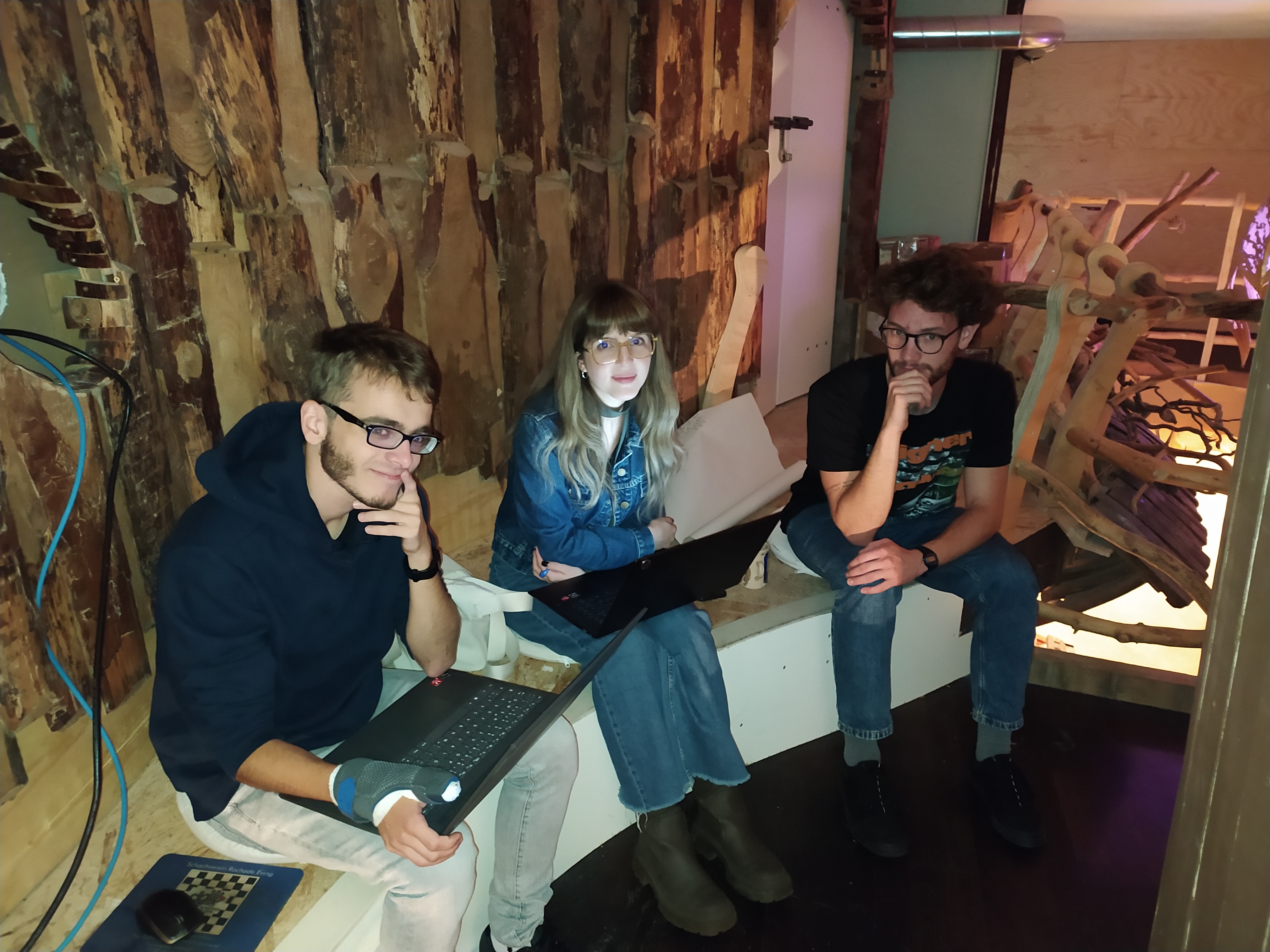
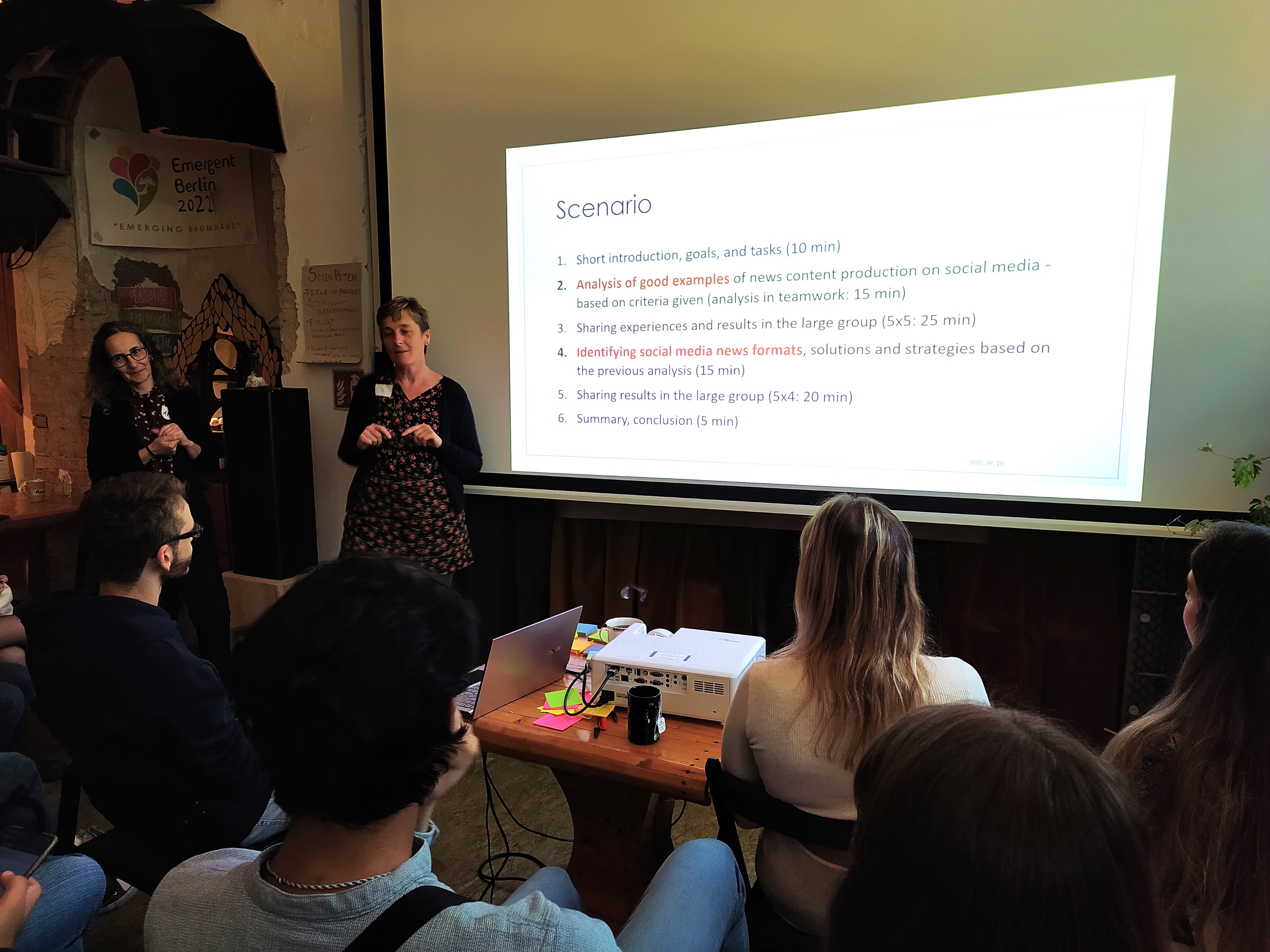
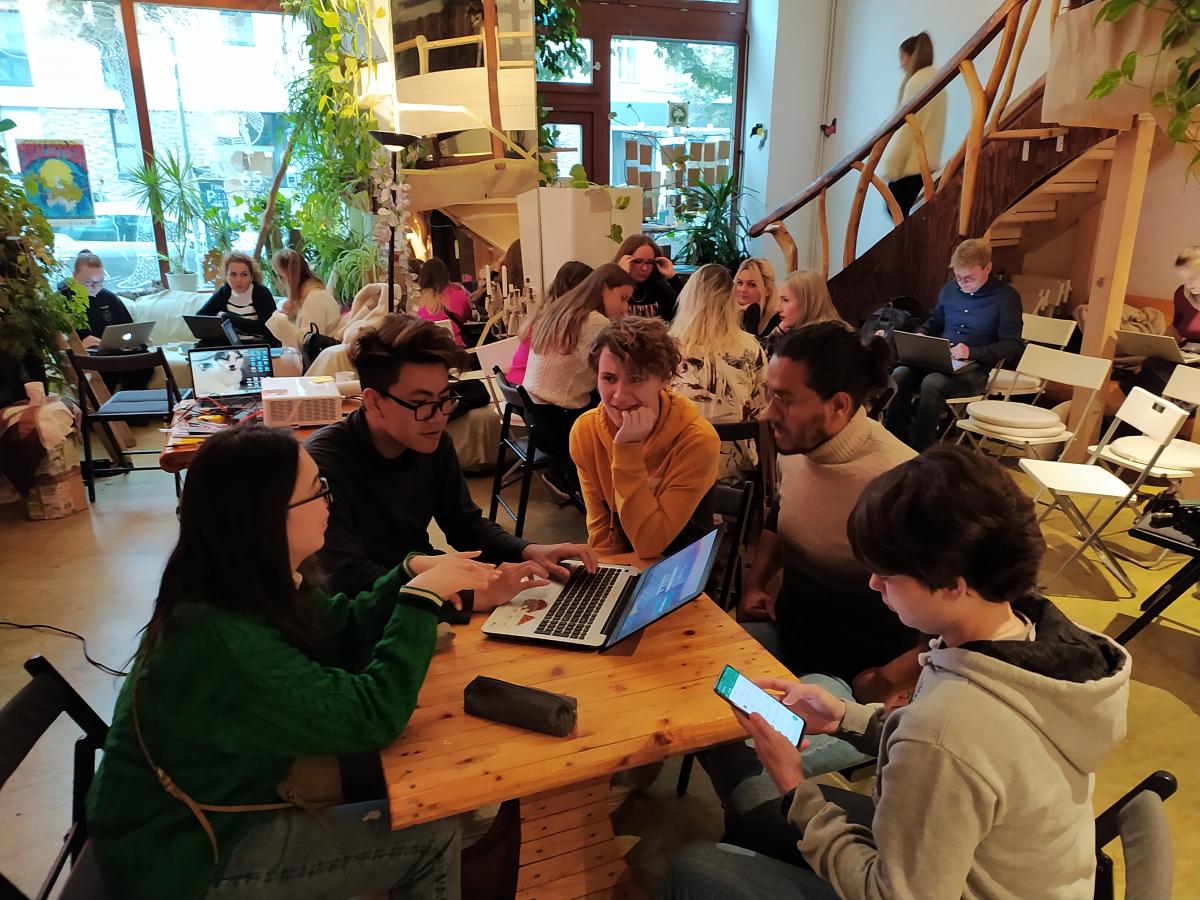
During the five-day long event, students fom the five partner universities joined forces: they participated in some specific workshops given by lecturers and researchers of NEWSREEL2, as well as developed their own cross-border collaborative projects in the form of international groups.

On the first day, after the programme and the participant lecturers were introduced, students had some playful activities to get to know each other. The session was led by Julia Vernersson and Zahra Salah Uddin from Hostwriter. In the meantine, researchers of NEWSREEL2 organized a transnational project meeting to discuss the next steps of the project.

The summer school continued on Tuesday, when students took part two workshops. One of them was connected to cross-border journalism (lecturers were Dominik Speck from the Erich Brost Institute & Tina Lee from Hostwriter), while the other one was based on improving democratic sensibility (lecturer was Klára Smejkal from the Masaryk University).
In the afternoon, they started to brainstorming on possible group topics connected to the students assignments that they had to create before the summer school. The three main topics were: (1) composition of mainstream media coverage; (2) media consumption and trends; (3) trust in news and journalism. The main issues related to these three themes were collected as 'hot topics', then students selected a topic that was interesting for them. As a result of that, five groups were formed, which started to work on their project. The teams presented their specific project plans in the framework of a pitch session at the end of the day.

On the third day of the event, two additional wokshops were held connected to the fields of storytelling in social media (lecturers were Rita Glózer from the University of Pécs & Ana Pinto-Martinho from the ISCTE - University Institute of Lisbon) and debunking disinformation (lecturers were Antonia Matei & Marian Popovici from the University of Bucharest).

After lunch, students continued to work on their project which they started the day before. At the end of the day, the groups reported on the progress of their project work.

On Thursday, the student groups finalized their project works with the help of lecturers, and created their presentations for the multiplier event. The programme ended with a relaxing session, where they were asked to give feedback on the summer schoool, based on some specific aspects.

On the final day of the Summer School, students attended the multiplier event of the NEWSREEL2 project with the title of "Shrinking Civic Space: New Media, Democracy & the Future of Journalism" and had the opportunity to present their project works to a professional audience.

T
he presented projects were: Transitioning to wind energy or just rambling about it?, Infectious Project – How COVID-19 became an infodemic, Journalicity.project, Beauty Check and #Tiktok Made Me Buy It.

Members of the groups were the following students:

Transitioning to wind energy or just rambling about it?: Martin Gunis (Masaryk University), Andra Muresane (University of Bucharest), Jakub Radan Dvorak (Masaryk University) & Nick Gehrmann (TU Dortmund).

Journalicity.project: Madalena Vieira (ISCTE - University Insitute of Lisbon), André Rocha (University of Pécs), Marie Kolajová (Masaryk University), Klára Huvarová (Masaryk University), Manu Magalhaes (University of Pécs), Mariana André Silva (ISCTE - University Insitute of Lisbon)

Infectious Project – How COVID-19 became an infodemic: Erica Fialho (ISCTE - University Institute of Lisbon), Charlotte Groß-Hohnacker (TU Dortmund), Bjarne Overkott (TU Dortmund), Hammad Saboor (University of Pécs), Viktorie Motlochova (Masaryk University), Paula Hammerschmidt (TU Dortmund), Joana Lopes (ISCTE - University Institute of Lisbon), Marta Rodrigues (ISCTE - University Institute of Lisbon)

Beauty Check: Alexandra Stamatescu, Teodora Geambei & Anna Constantin (University of Bucharest)

#Tiktok Made Me Buy It:  Norbert Nemes (Masaryk University), Nguyen Xuan Thai (University of Pécs) & Meerimai Muratbekova (University of Pécs)

The teams of Beauty Check & #TikTok Made Me Buy It collaborated together to get some different perspectives on their similar topics.

After the presentations, all of them received a certificate of the successful completion of the Summer School.

Thank you very much for the amazing project works and a huge thank you for the team of Hostwriter for hosting such a great event!

Gallery from Monday to Thursday: https://newsreel.pte.hu/media/gallery/summer_school_berlin

Project presentations in the multiplier event: https://newsreel.pte.hu/media/gallery/multiplier_event_berlin_student_pr...

Photos: First two photos by Annamária Torbó
            Last two photos by Charlotte Groß-Hohnacker


The Third Multiplier Event of NEWSREEL2 is coming!

NEWSREEL2 will organize the next multiplier event of the project in Berlin, together with Hostwriter, an NGO which helps journalists to collaborate all over the world. The event is the final programme of the five-day summer school in which students will introduce their project works to a professional audience.

Partners of the project will also present the first e-learning materials connected to some specific journalistic fields:

  • Storytelling in social media;
  • Improving democratic sensibility;
  • Foreign coverage;
  • AI and journalism, robot journalism and algorithms;
  • Verifying and analysing fake news & Debunking disinformation.

The pilot materials of these fields are available in the e-learning menu!

During the afternoon, there will be some interesting panel discussions with the title of "Free the Newsroom" and New Trends in Journalism. Between the two discussions, the audience will watch a documentary with the title of "Nothing About Us Without Us", which focuses on the refugees of Moria camp.

You can reach the FULL PROGRAMME HERE!


You can follow the event online via the Twitter channel of Hostwriter!


Summer School for Media and Journalism Students

The NEWSREEL2 summer school with the title of "Shrinking Civic Space: New Media, Democracy & the Future of Journalism" will take place in Berlin between 25 and 30 September. During the 5-day programme students from all five partner countries are going to work together in the framework of cross-border collaborative projects. The host of the event is Hostwriter, our partner from the NGO sector.

On the first day, students will have some activities that will help them to get to know each other. From Tuesday they will take part some specific workshops connected to the professional fields of the NEWSREEL2 project. Four workshops will be held by the project partners: one on cross-border journalism, one on improving democratic sensibility (which is the central topic of the summer school), one on storytelling in social media and one on debunking disinformation.

These workshops will give them inputs in the mornings, and the lecturers will help them during the afternoons to create their own journalistic contents  connected to three main topics: (1) composition of mainstream media coverage; (2) media consumption and trends; (3) trust in news and journalism. Students will work in international groups and present the results of their teamwork on Friday, in the framework of the multiplier event of the project. The full programme of the summer school is available here:

SUMMER SCHOOL PROGRAMME

If you are interested in the summer school, please follow our social media accounts (primarily on Instagram), because we will share more information there! And stay tuned for the detailed programme of the multiplier event!

Automated Journalism: Reality check

Automation processes are increasingly present in our everyday lives. These processes are now transversal to professions and practices, and journalism is not any different.



Automated journalism, also known as algorithmic journalism or robot journalism, consists of news articles generated by computer programs. Through artificial intelligence (AI) software, stories are produced automatically by computers rather than human reporters. These programs interpret, organize, and present data in human-readable ways. The process involves an algorithm that scans large amounts of data, selects from an assortment of pre-programmed article structures, orders key points, and inserts details such as names, places, amounts, rankings, statistics, and other figures.

Despite it being a growing trend, there are still not that many media outlets worldwide working fully with automated journalism, so it is not deployed on a large scale, yet.

Pioneer adopters include The Associated Press, Forbes, ProPublica, and The Los Angeles Times. Early implementations were mainly used for stories based on statistics and numerical figures. Common topics include sports recaps, weather, financial reports, real estate analysis, and earnings reviews (Montal & Reich, 2016).

At the NEWSREEL2 project we tried to understand the state of use of AI, robot journalism and algorithms in the Czech Republic, Germany, Hungary, Portugal, and Romania, talking to five journalists, one in each country.


Opportunities and challenges

Th
e world of automated journalism encompasses opportunities and challenges. For example, automated journalism can free journalists from routine reporting, providing them with more time for more complex tasks and profound reporting. It also might allow efficiency and cost cutting, alleviating the financial burden that many news organizations have been facing.

But automated journalism is also perceived as a threat to the authorship and quality of news and a threat to the livelihoods of human journalists. All this because the promise of getting more time for complex jobs such as investigative reporting and in-depth analysis of events, mentioned before, might not be accomplished.

So, in general, the main criticisms are related to authorship, credibility, quality and, looking to other activities where humans were replaced by real or virtual machines, that brings out the topic of employment.

For Rui Barros, a Portuguese data journalist, one of the downfalls for AI produced content can be that the readers feel that the text is produced by an algorithm due to “some grammatical inconsistency or some edge case that was not thought of when the product was developed”. This reinforces the need for human supervision and editing.

Steffen Kühne, from Germany, stresses out that another specific problem that tends to happen in a newsroom is linked to the integration of new software into the existing legacy systems: “Incompatible interfaces or data models are oftentimes responsible for large development and management overhead. Training and deploying AI models in a cloud infrastructure can also be quite expensive and requires in-depth knowledge on how to optimize algorithms for speed, efficiency, and stability”.

Another important note is the need for transparency, in what regards the way algorithms are used and how the automated work is done and for what is used. This is linked to  journalism and ethics, as it is to the trust in journalism.

Although there are many challenges in the present and future, the introduction of AI in journalism is growing, and projects such as JournalismAI, from the London School of Economics in partnership with Google News Initiative, intend to contribute to a wider and better use of it, allowing media organizations to explore how they could use AI technologies to approach a series of challenges, and support a growing network of almost 3,000 journalists across the world.


Reality check:  five countries, five different stages

There are substantial differences about the use and evolution of AI in journalism across different countries. To check if the perception of a global automation trends matches the newsroom reality in European countries, we interviewed journalists from five countries about AI and journalism, robot journalism and consequently algorithms: Czech Republic, Germany, Hungary, Portugal, and Romania.

Despite the differences in each country’s evolution of AI and journalism in the newsrooms, most of our interviewees agree that the use of such techniques in the newsrooms will be inevitable, so skills and literacy in these areas are crucial.

Of the five interviewees, those from the Czech Republic, Germany and Portugal report that AI was being used in their newsrooms. This is not the case in the newsrooms of our interviewees working in Hungary and Romania. But, from the five, only one of the interviewees is dedicated more specifically to work with automation, all the other have other tasks.

Most of our interviewees that work with AI use it for automated reporting, in the broader sense, for example to cover a lot of stories that happen regularly and where results can be quantified (be transformed into structured data). The most common examples quoted were reporting about sports, economy, health, weather, and traffic information. The interviewees are unanimous about the potential in using automated reporting, but some of them point out that some stories would largely benefit from human editing and context work.

In a growing area like this, having the right skills is crucial. Most of the journalists we interviewed are self-taught, sometimes reading and looking for information that helps them experiment, so it is clear that this is an area where there is a need for training. Yet, according to most of them, training programs should consist of several levels – from basic to more advanced – also because the implementation of AI into newsroom routines differs considerably between the studied countries.

In general, the importance and inevitability of AI in the newsrooms is recognized by all our interviewees, although the stage in which newsrooms are is very different from country to country. The challenges that journalism faces ahead in several areas are big, this one more, there ethical, social and more practical implications in adopting AI in the newsrooms, but the way is being paved by some media outlets.


Special thanks to Radka Matesová Marková ( Editor-in-Chief at Česká tisková kancelář – Czech Republic), Zsuzsanna Dömös (Technology journalist at 24.hu – Hungary), Steffen Kühne (Tech lead for the AI + Automation Lab at Bayerischer Rundfunk – Germany) and Rui Barros (Data journalist at Público – Portugal).

The full reports of the study are available within the NEWSREEL2 research report.

This article was written by
Ana Pinto-Martinho and Miguel Crespo (ISCTE - University Institute of Lisbon).

Photo: Pixabay