The first multiplier event of NEWSREEL
Venue: Bundespressekonferenz Berlin, Germany Date: 14th June 2018
Photos: Johanna Mack (EBI)


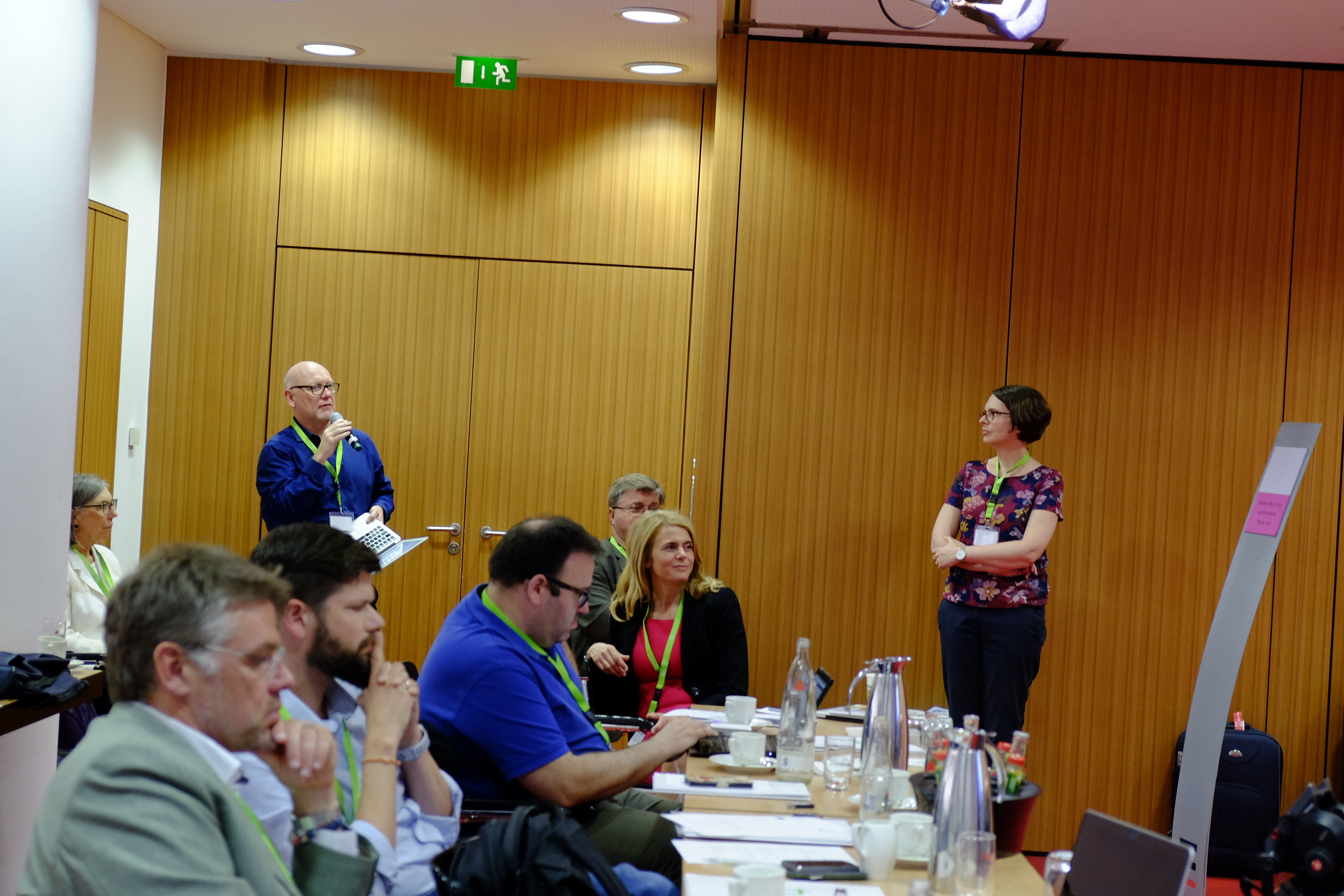
Venue: Bundespressekonferenz Berlin, Germany Date: 14th June 2018
Photos: Johanna Mack (EBI)
Venue: Law Faculty, University of Bucharest, Romania Date: 25th September 2018
You can also see some pictures from the transnational project meeting (24 September).


 New ways of financing journalism projects are one of the hottest topics in the contemporary media field. However, it is tough to find innovative business models that work successfully in the long run. Most of the media outlets try to combine traditional financial models with new ones. Some best-practices worldwide range from different advertising models, paid content, sponsorship and membership, to selling non-media products. The audience has a more significant role than ever, because they are not just consumers anymore, but can also appear as financers, for example in the case of crowdfunding. During Phase 1 of our project, we analysed new business models in the media field and the university curricula of Romania, Hungary, Germany and Portugal.
Business models in the media
Difficulties in Romania and Hungary
In Romania, due to oligarchic influences, new business models become more and more prominent. In the Romanian market, newsrooms set up as NfPOs (non-for-profit-organisations) became very valuable - like RISE project and the Romanian Centre for Investigative Journalism. NfPOs produce professional reporting, and are financed on a non-profit basis, and are usually part of international networks. These organisations can also attract more support through crowdfunding.
Hungary also suffers from oligarchic interferences connected to state influence. Furthermore, there are no paywalls, metered or freemium contents on the media market. However, the independent investigative teams like Átlátszó - that played a pioneering role in crowdfunding, and Direkt36 have successful crowdfunding campaigns. One of the biggest news portals, 444 also uses crowdfunding just like a small local portal Szabad Pécs (Free Pécs).
The huge problem is that neither the Romanian nor the Hungarian mentality does favour these new kinds of models: people are usually reluctant to pay for online journalistic contents. It is tough to change this attitude, but Anita Vorák (Direkt36) would prefer to have full crowdfunding because then they could be more independent. Augustin Roman (Digital Antena Group) said that most of the new innovative business models in Romania have somehow failed to produce the expected outcome for mainstream media.
Innovative experimentations in Germany and Portugal
In Germany, there are various forms of paid-content models. About one-third of daily newspapers had set a paywall on their webpages in 2017. However, it is not so common to hide all of the content behind paywalls; therefore, the majority of the mediums still offer their online content free. Media outlets are also experimenting with freemium models (where people have to pay only for exclusive contents) or metered models (where users can read a certain amount of text for free). Crowdfunding is not so popular, but some media organisations have tried this innovative way, such as Krautreporter. Although the non-profit investigative newsroom Correctivhas foundations and philanthropic funding, these are not the only pillar of their business model. They steadily develop further streams of income in the form of memberships fees or donations. Curiously, most of the German interviewees thought that even Germany is an "underdeveloped country" regarding paid content. According to journalism professor Tanjev Schultz, one of the reasons can be that digital pay models were introduced too late in Germany.
In Portugal, both the legacy and new media are experimenting with innovative revenue streams from native advertising and branded content to metered paywalls. In 2015, on behalf of the Portuguese media regulatory body Entidade Reguladora para a Comunicação Socia(ERC), ISCTE-IUL conducted some academic research. None of the interviewed Portuguese journalists felt comfortable talking about this aspect of journalism, but they agreed that it is vital to find new business models. The journalism project É Apenas Fumaça (It is just smoke) that has just won funding from the Open Society Foundation was mentioned as a good example.
 Innovative business models in higher education
All of the Romanian, Hungarian, German and Portuguese institutions in the research sample have integrated elements of media economics; however, only a few academic, journalistic programmes put new business models into the focus.
Basics and some particular aspects in Romania
In Romania, the University of Bucharest prepares journalism students to think about financial constraints, challenges and possibilities. At Master's level, they also offer a unique programme in Media Management. At the Alexandru Ioan Cuza University,students can learn about basic economics in the framework of the ‘Theoretical Introduction to Economics' course. Other higher educational institutions offer students the opportunity to discuss new business models, and other courses deal with media economics and current developments.
Personal branding is important in Hungary
In most Hungarian universities, new business models are not in focus. Nevertheless, there are a few courses, which contain some aspects of these new business models. The Budapest Metropolitan Universityoffers a course on personal branding for journalists. András Murai believes this is very important as nowadays the chance of becoming a full-time journalist has diminished, and therefore students have to learn how to move in several directions as freelance journalists. A general PR communication course at the Eötvös Loránd University e.g. covers the topic of personal branding; moreover, they offer a course where students learn about the social media stars’ business models.
In Germany, students can develop innovative business plans
In Germany, five of the six curricula observed, tackle questions of how to finance journalism in the future and teach and discuss new business models. The program in Hamburg is the only one that does not operate a course on business models. According to the head of the department, Michael Brüggemann, they believe “[..] journalists should not have to worry about how to finance journalism. Developing business models should be in the hands of media managers.”
General courses are also available in most faculties of the sample like ‘Introduction to journalism’, ‘Media economics’ or ‘Current developments in journalism’. However, some put a strong focus on this topic, like the programmes at Cologne, Dortmund and Stuttgart. They all offer specialised courses on business models, but only Stuttgart has a great emphasis on innovations. Journalism students at Cologne have the opportunity to attend different courses on business planning and management; furthermore, they have to develop their business plan. At Dortmund, there are specialised courses where ‘editorial analytics’ and ‘consequences of algorithms’ are also covered. At Stuttgart, in the framework of the ‘Innovation management’ module, students develop business prototypes for specific cases from the field. It is an excellent opportunity because media practitioners rate the student's ideas and sometimes implement them in their media outlets.
In Portugal, specific courses should have much more attention
In Portugal, only two of the investigated programmes offer specific courses on business models, and both are in the capital city. At ISCTE-IUL, students can learn about‘Entrepreneurial Journalism and Media Economics and Business’ and at the University Autónoma of Lisbon about‘Media, Economics and Business'. In other programmes, more general courses contain these questions. On the other hand, business models are considered to be very important, because according to lecturer Luís António Santos “business models allow the students to have an idea on how the business works and understand the potential for future use”. Journalist Elisabete Rodrigues also argued that these issues should be part of the journalism and media programmes.
Consumers’ attitude needs change
 Nevertheless, there are promising developments mostly in the German media and education, whereas newsrooms and universities in Romania and Hungary have to face economic and political constraints. However, some new collaborative journalism networks have evolved recently, which have set up new business models to finance their projects. Hungarian journalist Gergely Dudás is currently working on the launch of a crowdfunded news portal Politis.hu and struggling with consumers' attitude who do not want to pay for online news – this is not a unique Hungarian phenomenon, the Romanian, German and Portuguese journalists also struggle with this mentality. Sometimes even journalists and journalism educators do not see the need for transforming the business model of a medium, and this attitude can become very problematic in the long run.
You can find the full sample of the universities in our research report(page 40-43). If you would like to read more about the role of new business models in the partner countries, check our report as well.
Featured image by Marco Verch (flickr)
Other pictures: Pixabay

Data journalism and data visualization become more and more important in the new media landscape, while most of the journalists need to acquire skills like how to collect, organise, analyse and present data at an advanced level. Our research report highlights the role of data journalism in the four partner countries of NEWSREEL and how this field appears in the higher education of Germany, Hungary, Portugal and Romania.
Data journalism in the media
Regarding data journalism in practice, this field needs to be improved in all four NEWSREEL countries. Although there are some good practices everywhere, the number of data journalists are very low even in Germany, which has the highest number of data journalists among the partner countries (about 50). This number is in sharp contrast with the Hungarian reality, where only one journalist calls himself a data journalist.
Difficult circumstances
There are several problems to face with, e.g. the lack of time and (re)sources, as well as the shortage of technical skills. According to a Hungarian specialist, Attila Bátorfy, the large newspapers in the Western European countries could set up teams for data journalism, but their counterparts in Hungary have to do all the programming, data extraction, analysis, interpretation and data visualization on the their own. Moreover, the limited access to data often hinders journalists to do this specific type of journalism.
Although data journalism is very expensive, it is mostly applied by non-profit media organizations everywhere, which often cooperate with independent and innovative media outlets.
Types of data journalism
The different national overviews point out that data journalism is mostly used in investigative, economic or political reports, like in articles on elections. In Germany, data journalism appears also in the field of entertainment, such as sports.
From the interviews with the German and Portuguese journalists, it emerges that most of the work in data journalism is linked to collaborative investigative journalism, like in the case of the Panama Papers, where there were massive amounts of data and a big team had to collaborate.
In Hungary and Portugal, there are only a few examples for data journalism, whereas in Germany there are many interesting data journalism projects. Actually, two foci have been evolving there. One of them is the interactive and visual data journalism, practised by the Berliner Morgenpost e.g.. The other one is a type of investigative data journalism, which can be observed in the works/projects of the Süddeutsche Zeitung, BR Data or Correctiv.
 Data journalism in the higher education
In all four samples of the NEWSREEL countries, there are universities that offer courses on data journalism, however there are huge differences in to what extent these institutions pay attention to this specific field.
Extensive offer in Germany
Maybe it is not surprising that Germany also leads the line concerning university courses of data journalism. We can find data journalism courses in all six German journalism programmes, however, the amount of acquired knowledge and practice is very different (this is also true for the offer of other partner countries). On BA level in the science journalism programme at the TU Dortmund University, data journalism has a significant role. Other faculties in other universities have modules and workshops or integrate some aspects of data journalism into their curriculum. The departments at Hamburg, Dortmund and Cologne are eager to enhance their data journalism offer in the future.
Adequate offer in Romania
In Romania, the University of Bucharest and the Babeș-Bolyai University offer basic and advanced level courses in the field of data gathering. Moreover, at the University of Bucharest, there are data journalism courses both at Bachelor and Master level. The Journalism and Communication Sciences Department at Alexandru Ioan Cuza University also offers a data journalism course. At the Lucian Blaga University, on the other hand, there are no special courses in data journalism, but some elements of data journalism are integrated into the online journalism course. The West University of Timișoara give only the basics of data journalism. To date, Spiru Haret University does not run a course in data journalism.
Small supply in Hungary and Portugal
Hungary has only two universities where data journalism is available as an independent course: at Budapest Metropolitan University and at Eötvös Loránd University, and the same data journalist teaches students in both institutions. Some elements of this field are also taught in the other programmes, integrated into other courses, like ‘Presentation technologies’ (University of Debrecen). At Pázmány Péter Catholic University, students have the possibility to learn about infographics. At the University of Szeged, there is a demand for teaching data journalism, but the suitable personnel are not available.
In Portugal, data journalism as a specific course is only offered in the postgraduate programme at ISCTE-IUL. The course aims to provide basic knowledge ranging from choosing the right sources, treating and analysing data to visualising data, and storytelling with them. Other universities have some courses on visualisation, e.g. the University Autónoma of Lisbon, but they have a broader focus, including print infographics. In some universities there are workshops or journalistic projects connected to this area (like the University of Minho).
Data journalism should be a priority

As the country reports show, data journalism is a very promising field, but the necessary frameworks to do and teach this specialized type of journalism properly are unfortunately not available everywhere. The biggest problems are the lack of time and money, because data journalism is a very time- and cost-consuming field in digital journalism. Huge international projects and journalistic networks can serve as good examples. Creating the conditions for data journalism however should be a priority at all levels of national institutions.
You can find the full sample of the universities in our research report (page 40-43). If you would like to read more about the role of data journalism in the partner countries, check our report as well.
 In phase 2 of the project we have developed detailed syllabi for establishing the structure of the e-learning materials of phase 3 and embedding these materials into the programs of journalism studies. Each partner country has developed one syllabi, therefore we have 4 syllabi in the following topics: Data Journalism and Visualization by the University of Bucharest, Collaborative Journalism by the Erich Brost Institute, News Media Business, Innovation and Project Development by ISCTE University Institute of Lisbon, and Ethical Challenges in Digital Journalism by the University of Pécs. In the materials the discipline objectives, the content of the courses are available, as well as the compulsory and additional bibliographies.
The syllabi can be downloaded from here:
Data Journalism and Visualization
Collaborative Journalism
News Media Business, Innovation and Project Development
Ethical Challenges in Digital Journalism
At the end of phase2, the representatives of NEWSREEL presented the four developed syllabi in the framwork of a 'Future journalism curricula workshop' . The program was held at the Law Faculty in the University of Bucharest on 25 September 2018 and was opened by Prof. Mihai Coman, Dean of the Faculty of Journalism and Communication Studies. First of all, the representatives of NEWSREEL introduced their syllabi for the local and invited international audience of academics and practitioners. NEWSREEL was represented by:
Gábor Polyák and Annamária Torbó, University of Pécs, Hungary - Ethical challenges of the digital public sphere
Ana Pinto Martinho and Miguel Crespo, ISCTE - Lisbon University Institute, Portugal - New business models of journalism
Tina Bettels-Schwabbauer and Nadia Leihs, Erich Brost Institute, Germany - Collaborative journalism
Emilia Șercan and Marian Popovici, University of Bucharest, Romania - Data journalism and data visualization
At the afternoon two round table sessions were held with the title of 'Challenges and opportunities for journalism education in 2020'. In the first part the needs of newsrooms and journalists, while in the second part the offer of journalism schools and the perspective of academics were in focus.
We will implement some changes based on the feedbacks of the event, and the developed syllabi will be available soon in our project website!
The research report with the title of "New Skills for the Next Generation of Journalists" was presented by the team of the Department of Communication and Media Studies from the University of Pécs (Hungary), the Erich Brost Institute (EBI) (Germany) and representatives of the ISCTE University Institute of Lisbon (Portugal) and the Faculty of Journalism and Communication Studies from the University of Bucharest (Romania).
The first dissemination event was held at the "Bundespressekonferenz" in Berlin on 14 June where the representatives of the research group presented the results of their comparative study for an international audience. Faced with new framework conditions in journalism in times of digitization, the researchers have dealt with the need for a new generation of journalists. The aim of the study is to strengthen the European democratic public toward to the new conditions.
The presented report concentrates on the teaching of journalism and the different prerequisites in the education of the participating countries. It specifically focuses on the four aspects of data journalism, collaborative journalism, new business models and media ethics. The results of the research are based on an analysis of the university programmes' curricula in the four countries as well as on interviews with journalists and journalism educators in Hungary, Germany, Portugal and Romania.
Photos: Johanna Mack (EBI)
 The aim of phase 1 of NEWSREEL was to ground the development of syllabuses and teaching materials that can be incorporated in journalism education at universities and that are able to reflect on the needs of the stakeholders in the participating countries. The initial conditions – e.g. the state of journalism education regarding new skills and tools of journalism, the spread of journalistic performances based on new skills and tools – are different in the participating countries, and these are not necessarily mapped in published analyses. Therefore in the previous months we have done interviews with representatives of the selected universities' journalism departments, as well as with practising journalists in each country. Besides the interviews, we have also analysed the curricula of the selected departments, especially that how our four specific fields - data journalism, collaborative journalism, new business models and ethical challenges - are integrated into the education. If you are interested in our results, you can reach the full research report here:

Title photo: Judith Wiesrecker